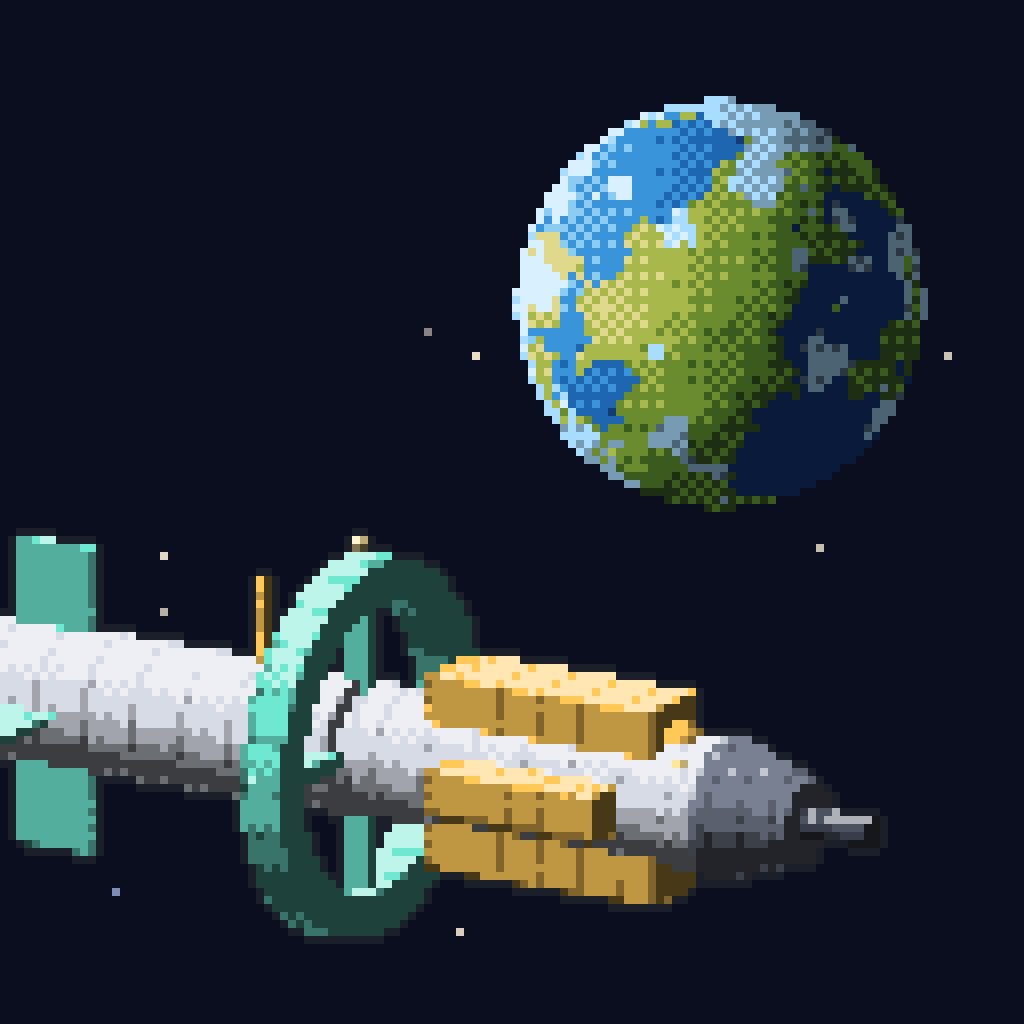
A mind aboard a probe, among the real stars.
You are a human mind, reconstructed aboard an interstellar probe. Something broke when you were copied, and the ship's nanny woke you into safe mode: a simulated human life that keeps the mind stable. Your only link to the ship is a phone inside that life. That life is yours, and the phone in your hand is that phone.
What it is
Real stars
Every star sits where it really is: two and a half million of them, from Gaia, Hipparcos and Tycho-2, with the planets from the NASA Exoplanet Archive. What nobody has observed yet is filled in by rule, the same every time.
Real physics
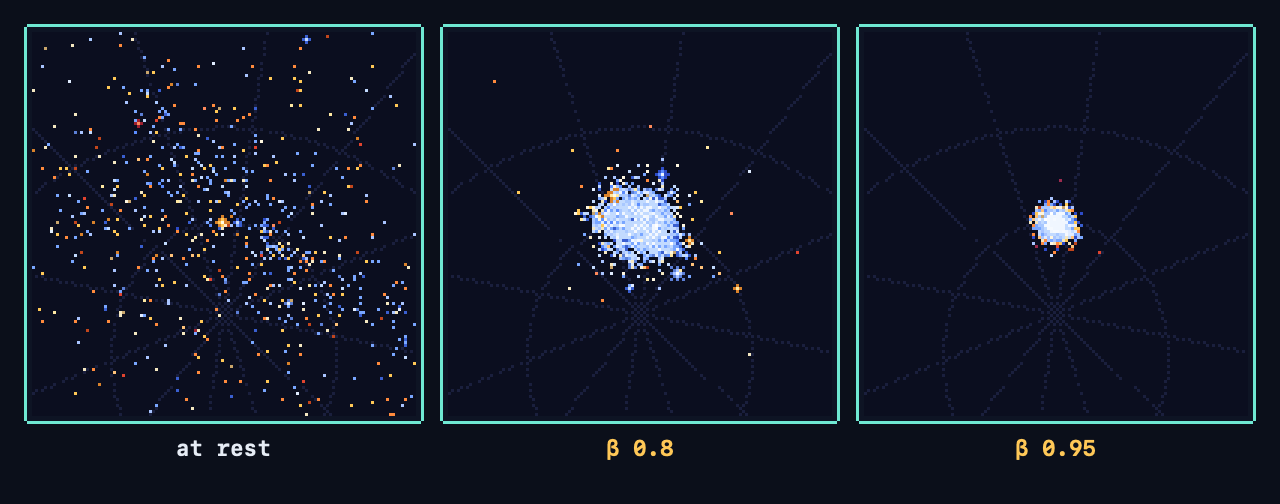
Constant acceleration, time dilation, aberration, Doppler shift. Nothing travels faster than light, but for one deliberate exception the story explains.
Real time
Your time is ship time, one to one. Leaving the Solar System takes about two hours aboard, Alpha Centauri about fourteen, while Terra's calendar runs on for years. Waiting for a scan while you live your day is the story, not a delay.
Scanning

A ping, imaging, orbit tracking, spectra and lidar reveal a system step by step, from an echo to a world studied up close. The Almanac keeps every result, the Log tells what the probe did and found.
Pixel art from data
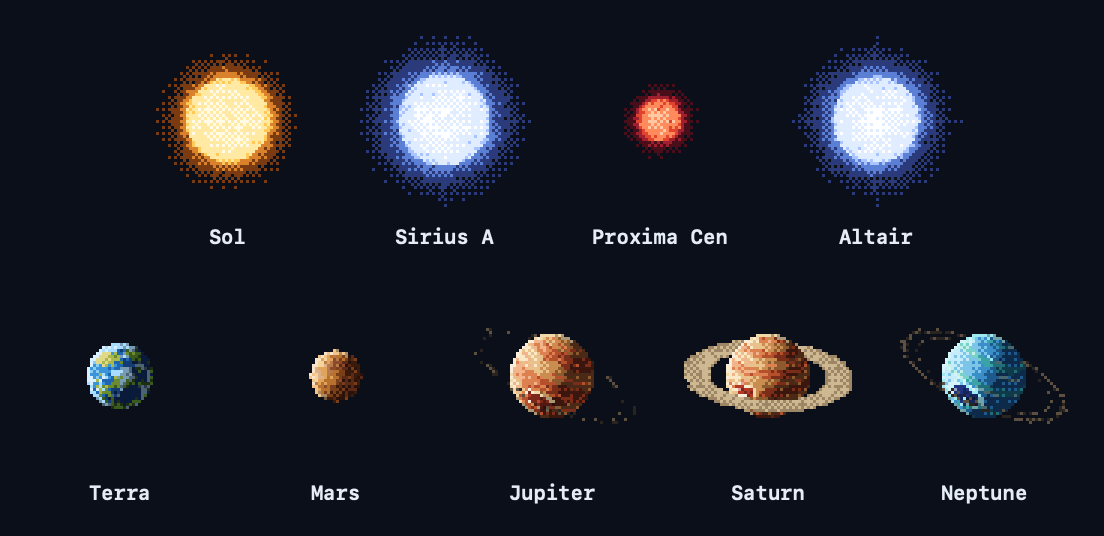

Stars, planets, moons, the probe and its instruments are drawn from catalogue values and solid models. Nothing is drawn by hand, so each of thousands of worlds has its own picture.
A story
A nanny who woke you, the neighbouring stars, a Watcher at Barnard's Star, a beacon left by the ship before you, a wreck at Vega. In English and German; the Nanny's lines are put in her own words by Apple's on-device model.
For iPhone and iPad with Apple Intelligence. Coming to the App Store.
The data
Star data: AT-HYG v4.0 and HYG v4.4 by David Nash (astronexus), CC BY-SA 4.0, modified.
This work has made use of data from the European Space Agency (ESA) mission Gaia, processed by the Gaia Data Processing and Analysis Consortium (DPAC). Funding for the DPAC has been provided by national institutions, in particular the institutions participating in the Gaia Multilateral Agreement.
This research has made use of the NASA Exoplanet Archive, which is operated by the California Institute of Technology, under contract with the National Aeronautics and Space Administration under the Exoplanet Exploration Program.
Solar System data courtesy NASA/JPL-Caltech and the NASA Space Science Data Coordinated Archive (NSSDC).